Watching an Unfamiliar Tournament: A Pocket Plan for the First Round
A pocket plan for watching an unfamiliar tournament helps you follow one clear storyline, check important terms and understand what each result changes.
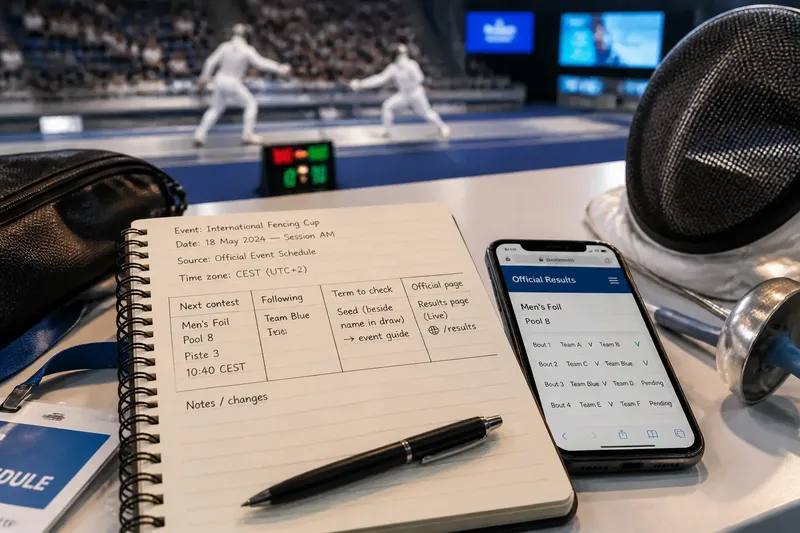
Watching an unfamiliar tournament is easier when you choose one storyline and know where to check its details. Before the opening contest, open the event schedule and official results page; keep a short note on your phone or a card beside you. You can leave the full rulebook aside until a specific question affects what you are watching.
The aim is not to predict the eventual winner. It is to keep track of what is happening now, what information would clarify it, and which details can wait until a break.
Set up a viewing note for this tournament
Start with the event’s name, the date of the session and the source you are using for the schedule. Add the displayed time zone, since an event page and a broadcaster may show different local times. If a start is delayed, check the latest schedule rather than relying on a saved screenshot.
Give your note four short fields: the next contest you plan to watch, the person or team you are following, an unfamiliar term to check, and the official page that can confirm it. Leave blank space for changes. This keeps the note useful without turning it into a second broadcast.
Imagine you are following a fictional fencing event and the schedule lists a pool bout before an elimination contest. You write down the bout’s time as shown by the event, mark that it is a pool contest, and save the official results page. When the time changes, you check that page and update your note; you have a reliable next step without trying to infer the whole event’s progression.
Choose a storyline rather than monitoring everything
Commentary, score graphics, standings and interviews can compete for your attention. Choose one thread that gives the contest shape: a particular team’s performance, a player’s role, a rival pairing, or a mark being pursued. Keep separate from that thread any claim about advancement unless the event’s published information supports it.
Write down a clear observation, such as “the team has won its opening contest” or “the athlete’s next attempt is still to come”. If the consequence is unclear, record the result and check the official results page during a pause. That is more reliable than treating a commentator’s shorthand as a rule.
In a group competition, the useful viewing thread is not a general account of how the table works. It is the particular contest or participant you have chosen, and the question you want to check next: who is playing, what happened, or where the result is recorded.
Check schedule details before they become distractions
Read the labels around the contest, not just its start time. Words such as “session”, “court”, “pool”, “heat” and “round” can tell you where an event is taking place or how the programme is arranged. Their precise meaning depends on the sport and event, so use the schedule’s own legend or event guide when a label is unfamiliar.
Note what comes immediately before and after the contest you have selected. That can explain why a broadcast changes events, why a participant appears again later, or why a result is not yet available. It does not require you to map every contest in the programme.
If the schedule uses a time zone you do not recognise, check the event page’s explanation before converting times. Keep the original time beside any conversion so you can compare them if listings are updated.
Keep event vocabulary separate from sport rules
An unfamiliar term can describe the contest itself or the way the event is organised. A word used in scoring or by an official during play belongs with the sport’s rules; a label beside a name in a draw may concern entry or placement in the event. The distinction helps you choose where to look.
Use three columns in your note: the exact term, where it appeared, and your working interpretation. For instance, write “seed — beside a name in the draw — likely refers to placement; check the event guide”. Preserve the surrounding phrase, too: a search for one word alone may return an explanation from another sport.
Look up terms that change your understanding of the action, the schedule or the result first. Leave decorative commentary for later.
Use this checklist when something is unclear
- Schedule label: Check the exact label beside your contest. If the event guide defines it, use that meaning; if it does not, keep the label as written and avoid guessing.
- Start time: Check which time zone the official schedule displays. If it matches your clock, keep it; if not, note the zone and compare with the broadcaster’s listing.
- Contest result: Check the official results page after play. If the result is posted, record it; if it is missing or provisional, wait for an update rather than treating commentary as confirmation.
- Unfamiliar term: Check the full phrase and where it appeared. If it concerns scoring or a decision during play, consult the sport’s rules; if it concerns a draw or schedule, consult the event guide.
- Participant’s next appearance: Check the current schedule or draw. If a next contest is listed, add it to your note; if no pairing or time is confirmed, leave the field open and check again later.
- Changed programme: Compare the latest official schedule with your saved note. If the contest has moved, replace the old time; if no change is shown, retain the listing and check again near the session.
What should you check between contests?
How can I tell whether a time is local to the venue?
Look for a time-zone note on the event schedule or its help page. If the listing does not say, compare it with the broadcaster’s stated time and keep the event’s original time visible until you can confirm the difference.
Where should I check an unfamiliar event term?
Use the official event guide when a term appears in a draw, schedule or entry list. If it concerns scoring or a decision in play, look to the sport’s rules instead.
What should I do if a result is not posted?
Check whether the official page marks the result as pending or provisional, then return after the contest or session. Keep your note factual in the meantime; do not fill a gap with an unconfirmed broadcast graphic.
How much should I write down?
Record only the next contest, your chosen storyline and questions that affect what you are watching. If a detail does not clarify the schedule, action or result, leave it for another time.
Refresh the note when the programme changes
A viewing note should change when the schedule or available information changes. Cross out an obsolete time, replace it with the latest listing, and mark a result as provisional if that is how the official page presents it. Keep the source beside the update so you can tell confirmed information from your own working interpretation.
Say you are following a fictional swimmer at a championship and your note lists an afternoon heat, the event schedule’s time zone, and the official results page. The heat is moved to a later session, so you check the current schedule, replace the old session with the new listing, and leave the athlete’s next appearance blank until the draw or schedule confirms it. The resulting note tells you what changed and what remains unknown without suggesting that a further race is certain.
Keep the phrase watching an unfamiliar tournament tied to a simple habit: follow one clear thread, check important details at their source, and label uncertainty rather than smoothing it over. A short note that distinguishes confirmed information from questions is easier to use when the next contest begins.