Why a Match Clock Does Not Always Mean the Same Thing
A match clock can show elapsed time, active play or time remaining. Learn what each display means before comparing durations across sports.
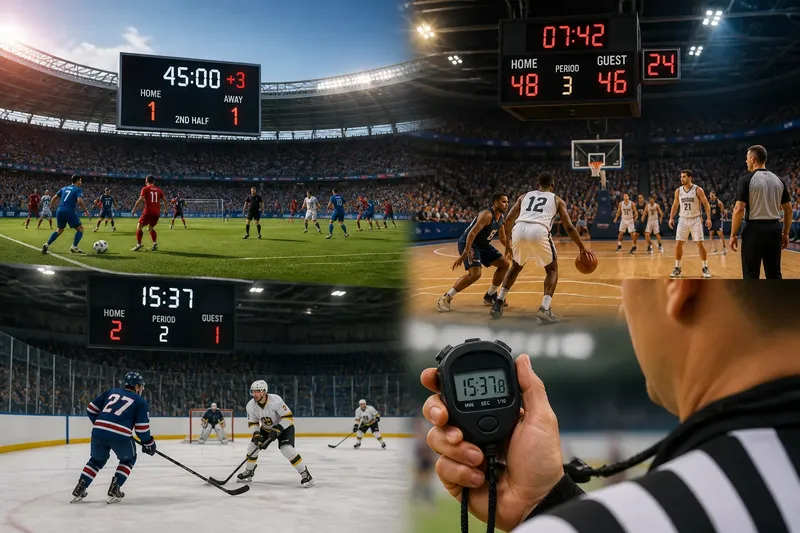
A match clock can show elapsed time, active play or time remaining, so a displayed minute does not mean the same thing in every sport. To compare match time sensibly, first ask what the clock is counting and what happens when play stops.
What does a match clock actually measure?
In some sports, the clock runs continuously through much of a period, including pauses for routine stoppages. It may be stopped only for particular interruptions, or continue until the referee or official ends the period. The display then gives a broad sense of elapsed match time, not a precise measure of how long players were actively competing.
Other sports use a countdown that stops whenever the action is interrupted. In that format, the display tracks the time still available for play, while the real interval between the start and finish of a period can be longer. A clock reaching zero may therefore signal that time has expired without indicating that the whole contest has lasted only as long as the countdown.
A third possibility is a clock that keeps running while a separate official decides whether an interruption merits added time. The display may appear to reach the end of the scheduled period before play is actually over. The referee’s signal, rather than the digits alone, determines when that period has ended.
When you first see a scoreboard, identify whether its numbers count up or down and watch what they do at a whistle or stoppage. That small observation often tells you more than the unit shown on the screen.
Why does the clock stop in some sports but not others?
Rules assign different jobs to timekeeping. A stopped clock can preserve a defined amount of playing time after an interruption; a running clock can keep the contest moving without pausing for every brief break. Neither approach says that one sport contains more action. They simply define the playing period differently.
Stoppages may include an injury, a review, a substitution, a ball or puck going out of play, or a referee’s decision. Which events stop the clock depends on the sport and sometimes on the competition’s rules. Even within one sport, a special end-of-period rule may make the clock behave differently near the finish.
In a continuous-clock format, a long interruption can be accounted for by added time or by an official’s discretion. The scoreboard may not show that adjustment in advance, so spectators should listen for the announcement or watch for the signal that play is continuing beyond the nominal endpoint.
When a clock stops, note the cause and whether the display resumes from the same point. This is especially useful when switching between sports whose broadcasts use similar-looking scoreboards.
What is the difference between a period and elapsed match time?
A period is a rule-defined segment of play; elapsed match time is the real time that passes from a chosen starting point. A game may have several periods, halves or quarters, with breaks between them. Those breaks usually do not belong to the displayed playing time, even though they contribute to the time a viewer spends following the event.
For instance, a countdown might begin at the start of each period rather than continue across the whole match. A count-up display might reset at a new half, or a broadcast may show a running total alongside a separate period indicator. Read the period label and the clock together before deciding what a number represents.
Say you are watching an invented indoor contest with two periods. The screen resets its countdown when the second period begins, and the official pauses it during an injury break; you can infer that the display tracks remaining playing time in the current period, not total time since the event started. The expected observable result is that the digits remain unchanged during the break and continue afterwards.
For a useful comparison, distinguish scheduled playing time from the length of the whole event, which also includes intervals, reviews and other pauses.
Why can the final whistle come after the clock reaches zero?
Zero can mean that scheduled time has run out, not necessarily that the contest must stop at that instant. In some formats, an official allows play to continue through an existing attack or until the ball is dead. In others, added time accounts for interruptions, with the referee deciding when the period ends.
That is why the final signal matters. The clock is an aid to applying the rules; it does not always make the decision by itself. If a broadcast clock and an official’s signal seem to disagree, follow the rules governing that competition rather than assuming the display is authoritative.
There may also be a difference between the stadium clock and the broadcast graphic. A television feed can use a delayed or simplified display, while officials rely on the timekeeping method specified for the match. Treat the on-screen figure as useful context, not a substitute for the referee’s decision.
How should you compare match duration across sports?
Start by separating three questions: how much playing time is scheduled, how interruptions affect the clock, and how long the event lasts in real time. A sport with a shorter scheduled clock can still occupy a longer viewing session if play pauses often or the event includes substantial intervals.
Compare like with like. “Playing time” is not interchangeable with “time from opening whistle to final whistle”, and neither automatically describes the broadcast duration. If a report gives only a clock figure, check whether it refers to a period, a half, the full contest or an added-time display.
When rules or timekeeping differ by competition, the relevant rulebook, broadcast explanation or official scoreboard legend is the best place to clarify the format. Names for periods and stoppages can vary, and local competition rules may set their own details.
A quick comparison should record the clock type, the number of periods and the treatment of stoppages. Keep those labels beside any duration you note.
What should you check before reading a new scoreboard?
Does the clock count up or down?
A count-up display usually reports time already used, while a countdown usually reports time remaining in a defined segment. Check whether it resets between periods, since the same direction can serve different formats.
Does the display stop at a whistle?
Watch one ordinary stoppage, such as a ball leaving play, and see whether the digits pause. If they keep moving, the sport may account for lost time separately or may not stop the clock for that event.
Who decides when the period ends?
Look for the referee’s signal, a timekeeper’s indication or an official announcement. The scoreboard can show that scheduled time has expired while the rules still permit play to continue.
Is this a period clock or a match total?
Read the period label and check whether the display resets at a break. A figure that starts over may describe only the current segment, not the entire contest.
The most reliable way to read a match clock is to treat its digits as part of a rule system, not as a universal measure of duration. Once you know whether it records elapsed time, remaining time or active play, comparisons become clearer—and a clock reaching zero becomes an event to interpret, not the whole story.